

You know the feeling. The day is over, but your body did not get the memo. Your mind is still racing through tomorrow, your shoulders are up around your ears, and that low hum of tension will not switch off. You have probably tried the usual fixes. A meditation app. Breathing exercises. A glass of wine to take the edge off. Some of them help a little. Most of them feel like you are fighting your own nervous system.
Here is the part nobody tells you: you already have an off-switch for stress. It is a physical nerve, and you can reach it on purpose.
It is called the vagus nerve, and cold water is one of the most direct ways to fire it.
Before you dismiss that, let us walk through what the research actually shows. Not influencer claims. Peer-reviewed studies with real data.
Meet your body-brain superhighway
The vagus nerve is the longest nerve of its kind in your body. It runs from your brain stem down through your neck and into your gut, and it is the master controller of your parasympathetic nervous system, the “rest and digest” side that brings you back down after stress. It governs your heart rate, your digestion, your breathing, and how fast you can shift from wired to calm.
Here is the key idea. The source of stress is not the stressor itself. It is your body's response to it. And that response runs through the vagus nerve. Train the nerve, and you change how hard life lands on you. The most studied way to stimulate it on demand is cold exposure, especially around the face and neck, where the nerve sits closest to the surface.
What the studies show
In a controlled crossover study published in Autonomic Neuroscience, Al Haddad and colleagues had people do a short cold-water immersion after exercise and tracked their heart-rate variability, the gold-standard signal of vagal “calm down” activity. The cold group's parasympathetic system rebounded faster, with a measurable jump in vagal HRV after just a few minutes in the water. In plain terms, cold pulled them back toward calm quicker than doing nothing.
A separate line of research on head-out and facial immersion explains why. Putting your face and neck in cold water loads the body's baroreflex and triggers the diving response, both of which push the nervous system toward the vagal, parasympathetic state. It is one of the more reliable ways we know to raise vagally-mediated heart-rate variability.
And it does not just calm you down, it sharpens you at the same time. In a 2023 brain-imaging study in the journal Biology, Yankouskaya and colleagues put 33 adults through a single five-minute cold bath. Afterward, people reported feeling more alert, attentive and active, while feelings of distress and nervousness dropped, and brain scans showed tighter coupling between the networks that handle attention and emotion. That combination, calm and clear at once, is the signature of a well-toned vagus nerve.
The exact protocol for training your vagus nerve
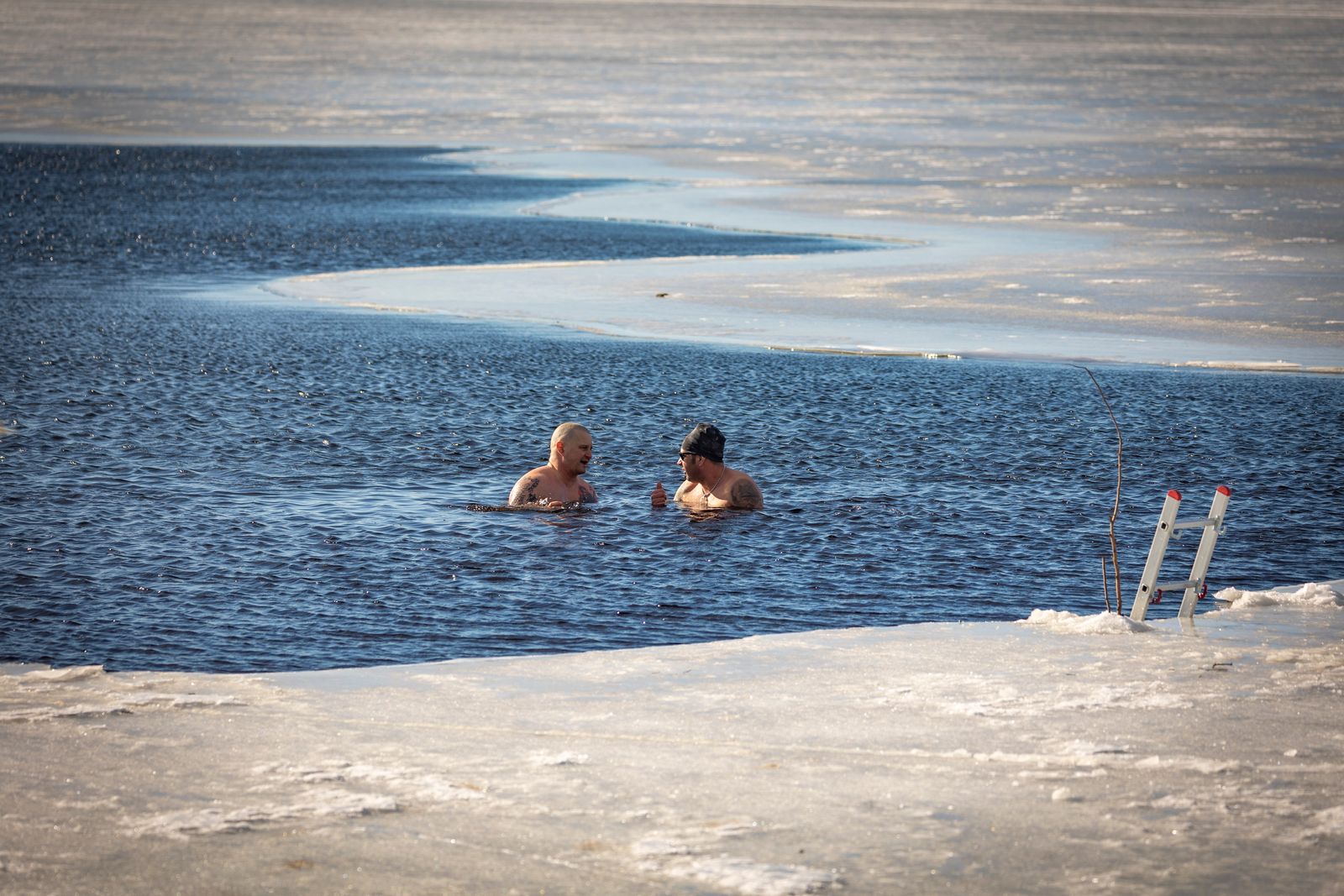
Temperature: 50 to 59 degrees Fahrenheit (10 to 15 degrees Celsius) is plenty to start. You do not need to go extreme. Colder is not better here.
Duration: 1 to 3 minutes. Aim for roughly 11 minutes of total cold across the week, spread over 3 to 4 sessions.
Submerge to the neck: The vagus nerve sits in your neck, so getting your shoulders and the base of your neck under water gives you the strongest signal. If you are easing in, start by splashing cold water on your face before you get in.
Breathe long and slow: This is the multiplier. Make your exhale longer than your inhale, for example in for four, out for eight. A long exhale is itself a vagus-nerve activator, so you are stacking two calming levers at once. Resist the urge to gasp and tense.
Finish calm: Step out and let your breathing settle for a minute before you reach for a towel. That settling moment is where the parasympathetic rebound happens.
What to expect
Your first session: The first ten seconds are loud. Your body wants to gasp and brace. Slow the exhale, and within about a minute a wave of calm usually rolls in. Most people step out feeling clear-headed rather than frazzled.
Days 3 to 5: This is where it gets interesting. People tend to notice they are a little less reactive during the day. The thing that would normally spike your stress lands a bit softer.
Week 2 to 3: With consistent practice you are effectively doing reps for your nervous system. The payoff is a longer fuse, a faster recovery after stress, and an easier time downshifting at night.
The bottom line
Stress is not a personal failing or something you just have to white-knuckle through. It is a nervous-system response, and you have a built-in dial for it. Cold water, applied with a little intention and a long exhale, is one of the most direct and best-studied ways to reach that dial and train it. Three minutes a day is a small price for a calmer, steadier baseline, and the research says your nervous system is far more trainable than most people ever realize.
References
- Al Haddad H, et al. Effect of cold or thermoneutral water immersion on post-exercise heart rate recovery and heart rate variability. Autonomic Neuroscience. 2010. https://www.sciencedirect.com/science/article/abs/pii/S1566070210000640
- Effects of adding facial immersion to water immersion on vagally-mediated heart rate variability. PMC11946671. https://www.ncbi.nlm.nih.gov/pmc/articles/PMC11946671/
- Yankouskaya A, et al. Short-Term Head-Out Whole-Body Cold-Water Immersion Facilitates Positive Affect and Increases Interaction between Large-Scale Brain Networks. Biology. 2023. https://www.mdpi.com/2079-7737/12/2/211
- Šrámek P, et al. Human physiological responses to immersion into water of different temperatures. European Journal of Applied Physiology. 2000. https://link.springer.com/article/10.1007/s004210050065
Financing available · HSA/FSA eligible
For the daily ones.
Cold plunges engineered to last, backed by 5,000+ owners and a US support team.
Shop cold plunges